 Attractions
  Hotel
Hotel  Restaurant
  Shopping
  Abroad





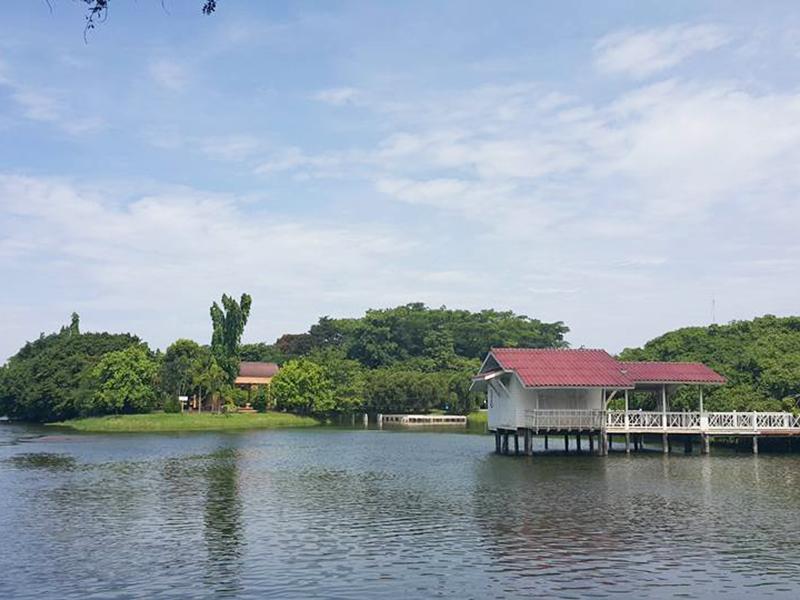

“The grandeur of the Banyan tree group extends over 1,000 square meters. The dense roots create natural tunnels and halls, providing a shady and cool atmosphere all day long.”
This majestic Sai Ngam complex in Phimai is composed of a giant cluster of Ficus trees that have expanded their aerial roots and branches over centuries, creating a truly spectacular natural landscape. The Banyan cluster is estimated to be over 350 years old. It is believed to have originated from a single banyan seed that sprouted on the bank of the Mun River. As its branches reached down, they took root in the soil, generating new trees in a continuous, complex cycle of growth, resulting in the dense, intertwined structure seen today.
The marvel of Sai Ngam is the natural phenomenon it creates, often called the "Banyan Forest" or "Banyan Tunnel," which covers an extensive area exceeding 1,000 square meters. From the outside, it appears as an immense, thick wall of tangled roots. However, once you step inside, you are enveloped in a surprisingly cool and shaded atmosphere, resembling a natural hall supported by pillars and ceilings formed entirely by the roots and branches of the trees.
Historically, the site was simply named "Sai Ngam" due to its overwhelming natural beauty. Later, between 1947 and 1957, the site gained spiritual significance. It is widely believed to be the dwelling place of a sacred entity, particularly Chao Mae Sai Ngam (The Goddess of Sai Ngam), a guardian spirit revered by the local community for centuries. A shrine to Chao Mae Sai Ngam has been erected within the area, under the deep shade of the trees, where people come to pay homage, pray for peace, and ask for blessings, especially concerning love and success.
The area surrounding Sai Ngam has been developed as an important ecotourism destination in Nakhon Ratchasima province. Convenient and safe walkways have been constructed, allowing visitors to thoroughly explore the grandeur of the root system. Furthermore, the site promotes the local economy by providing space for villagers to sell local products, agricultural produce, and Phimai regional foods. Thus, Sai Ngam is not merely a tree cluster; it serves as a spiritual gathering point and a hub for the local economy of the Phimai community.
How to Get There
-
Private car: Take Highway 2 (Mittraphap Road) until you reach the Talat Khae intersection. Turn right onto Highway 206 until you reach Phimai District. Upon reaching the district, head northeast. Sai Ngam is located along the Mun River.
-
Public transportation: Take a bus from Nakhon Ratchasima Bus Terminal to Phimai District. Then, take a tuk-tuk to the venue.
Travel Tips
-
Visit in the morning or evening to enjoy the fresh air and beautiful light for photography.
-
Spend about 1-2 hours exploring the banyan roots and branches.
-
Dress appropriately, as this is a respected place for locals.
Admission Fees:
- No admission fee
Opening Hours:
- Open daily from 8:00 AM to 6:00 PM.
Sai Ngam

 Share
Share
 Nai Mueang, Phimai, Nakhon Ratchasima, 30110
Map
Nai Mueang, Phimai, Nakhon Ratchasima, 30110
Map
 Open now : 8.00 - 18.00
Mon8.00 - 18.00
Tue8.00 - 18.00
Wed8.00 - 18.00
Thu8.00 - 18.00
Fri8.00 - 18.00
Sat8.00 - 18.00
Sun8.00 - 18.00



 2709
2709