 Attractions
  Hotel
Hotel  Restaurant
  Shopping
  Abroad





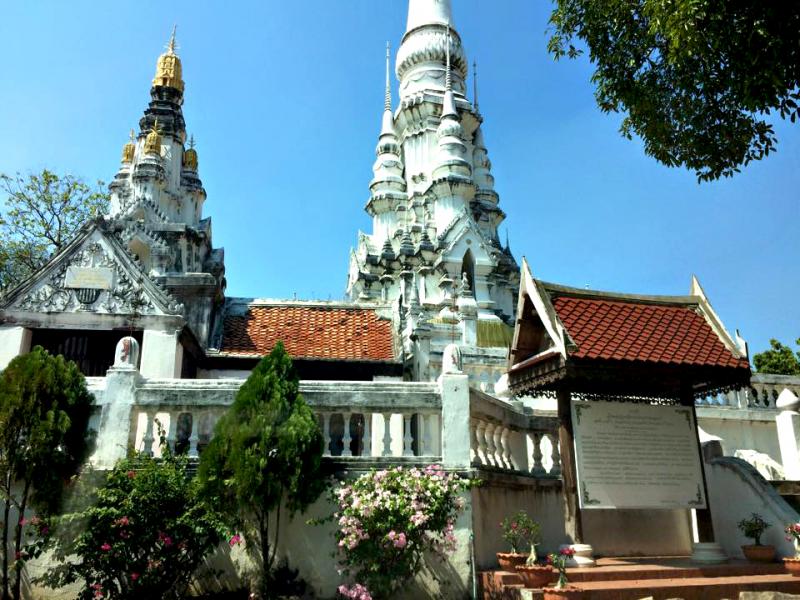

“Admire the pure white Five-Prang Pagoda enshrining Lord Buddha's relics and the unique backward-facing Naga staircase leading to the hilltop. Experience the sanctity of Tha Hin Lat, a historical site for collecting sacred water used in royal ceremonies.”
Khao Kaeo Worawihan Temple is a third-class royal monastery (Worawihan type) of great antiquity and historical significance in Saraburi Province. The temple was established around 1628 during the reign of King Songtham of the Ayutthaya period. It is located on a small limestone hill rising approximately 15 meters above the surrounding ground, making the temple clearly visible and giving it a peaceful and secluded atmosphere ideal for religious practice.
The name of the temple originates from a long-standing local legend. It is said that on full moon nights, villagers often witnessed a glowing “crystal orb” floating above the hilltop. Believing the site to be sacred, they named the hill “Khao Kaeo” (Crystal Hill), and the temple later inherited this name, which has remained in use to this day.
During the reign of King Mongkut (Rama IV), the monarch traveled to pay homage to the Buddha’s Footprint in Saraburi and stopped to rest at Khao Kaeo Worawihan Temple. Recognizing the site’s strategic location, tranquility, and historical value, he graciously appointed Chao Phraya Nikorn Bodin (To Kalyanamitra) to oversee a major restoration. The temple was then elevated to royal monastery status under the name “Wat Kiri Rattanaram” before eventually reverting to its original Thai name, Khao Kaeo Worawihan Temple.
One of the temple’s most remarkable features is the main chedi and the five-spired prang-style pagodas. These white Thai-style stupas enshrine sacred relics of the Buddha and his disciples. Surrounding niches house Buddha images in various postures, while the gable areas are decorated with murals illustrating Buddhist teachings, particularly themes related to contemplation of impermanence and the realms of hell, serving as moral reminders for visitors.
Another highlight is the Naga staircase leading to the hilltop. The staircase is beautifully adorned with colored glass and features a unique design in which the Naga turns its head backward. At the entrance stand guardian statues dressed in Western-style military attire, reflecting artistic influences from the early Rattanakosin period.
At the front of the temple along the Pa Sak River lies Tha Hin Lat, an important historical site where King Mongkut once stayed during his journey. Water from this area is regarded as one of the “Bencha Suddhikongkha,” the five sacred water sources used in significant royal ceremonies of Thailand.
Khao Kaeo Worawihan Temple thus represents a harmonious blend of Buddhist art, natural serenity, and rich historical heritage. It is an ideal destination for those seeking spiritual tranquility, historical knowledge, and a deeper understanding of one of Saraburi’s most important religious landmarks.
How to Get There
Private Car:
- From Saraburi town, take Highway 3041 (Saraburi-Sao Hai) toward Ton Tan Subdistrict. The temple is on your left by the Pasak River; the white pagoda on the hill is visible from a distance.
Distance:
- Approximately 10-12 kilometers from Saraburi city center.
Travel Tips
Viewpoint:
- Once you reach the pagoda at the top, you can enjoy a beautiful panoramic view of the Pasak River and the lush rice fields of Sao Hai district.
Preparation:
- The climb up the Naga staircase can be slightly tiring; it is recommended to bring water and wear comfortable walking shoes.
Nearby Places:
- You can easily visit the Thai-Yuan Folk Museum and the Ban Ton Tan Ancient Floating Market (open Sundays), as they are located very close to the temple.
Admission Fee
-
Free entry
Opening Hours
-
Open daily: 08:30 – 16:30
Khao Kaeo Worawihan Temple

 Share
Share
 Moo 1, Ton Tan, Sao Hai, Saraburi 18160, Thailand
Map
Moo 1, Ton Tan, Sao Hai, Saraburi 18160, Thailand
Map
 Open now : 8.30 - 16.30
Mon8.30 - 16.30
Tue8.30 - 16.30
Wed8.30 - 16.30
Thu8.30 - 16.30
Fri8.30 - 16.30
Sat8.30 - 16.30
Sun8.30 - 16.30



 20945
20945