 Attractions
  Hotel
Hotel  Restaurant
  Shopping
  Abroad






“Admire the Ubosot in the "Royal Preference" style of King Rama III, featuring an elegant gable without traditional horn-like decorations, and explore rare murals by master artisans from the King Rama IV era that seamlessly blend Buddhist stories with local folklore.”
Samuhapradittharam Temple is a third-class royal temple of the ordinary category and holds great historical significance for Sao Hai District in Saraburi Province. The temple was founded around 1821 during the reign of King Rama III by Chao Phraya Nikornbodin (To Kalyanamitra). It was built as a memorial and as a merit-making dedication to his mother, who was a local resident of the Sao Hai area. This reflects the deep connection between the ruling elite and the local community. The temple’s architecture and layout clearly represent the flourishing period of temple construction in the early Rattanakosin era.
The most prominent feature of the temple is its ordination hall (Ubosot), which was constructed according to the royal architectural style favored during the reign of King Rama III. The design is simple, solid, and dignified, notably lacking traditional decorative elements such as chofa, bai raka, and hang hong. The pediment is adorned with delicate stucco reliefs of floral and botanical motifs, demonstrating the refined craftsmanship of the period. Inside the Ubosot is enshrined Phra Phuttha Samuhapraditthawarayan, a Buddha image in the Maravijaya posture created in the Sukhothai artistic style. Its graceful and serene characteristics are rarely found in the central region, creating a profound sense of peace and reverence for worshippers.
Another aspect that deeply fascinates art historians and cultural enthusiasts is the mural paintings inside the Ubosot, which date back to the reign of King Rama IV and were created by master artisans. These murals are remarkable for their integration of Buddhist narratives with the everyday life of the Thai Yuan people of Sao Hai, including their clothing, housing styles, and community activities.
One of the most renowned mural series depicts scenes from the classic Thai literary work “Kaki.” These paintings are rendered with elegant lines, harmonious colors, and meticulous details. Beyond their artistic excellence, the murals serve as valuable cultural records, offering insight into the beliefs, lifestyles, and social transitions of Thai society in the past.
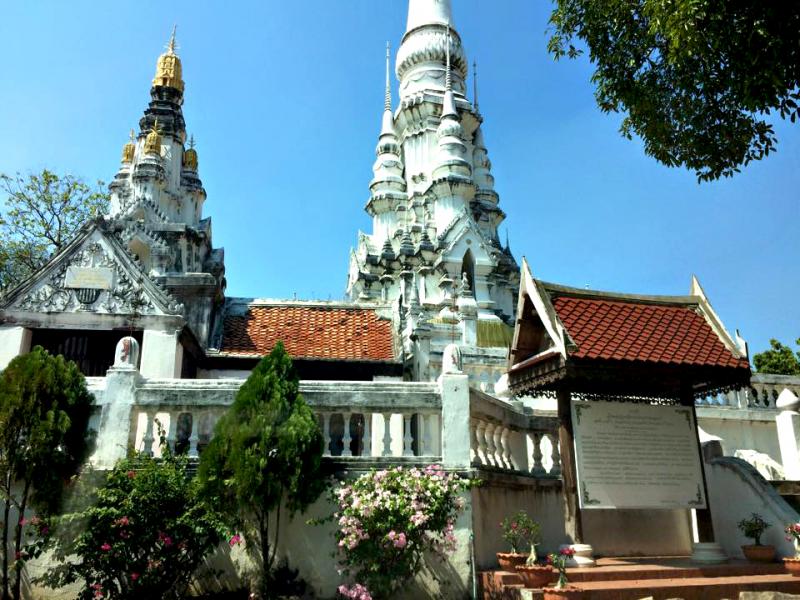
In addition to its artistic and historical value, the temple is set in a peaceful and shady environment, as it is located along the Pa Sak River. The temple grounds feature well-preserved twelve-cornered stupas arranged neatly around the Ubosot, enhancing the overall harmony and visual appeal of the site.
Samuhapradittharam Temple is therefore not merely a place of religious practice, but also an open-air museum of Thai art and history that preserves the cultural pride and identity of the people of Saraburi. It is a destination not to be missed for those who appreciate the refinement of Thai art and the rich narratives of the past.
How to Get There
Private Car:
- From Saraburi town, take Highway 3041 (Saraburi-Sao Hai). Cross the Pasak River bridge into Sao Hai district; the temple is on your left in Suan Dok Mai subdistrict with clear signage.
Public Transport:
- Take a local minibus (Saraburi–Sao Hai) from the Saraburi Bus Terminal, which stops directly in front of the temple.
Distance:
- Approximately 5-6 kilometers from Saraburi city center.
Travel Tips
Viewing Murals:
- Since the Ubosot may not always be open, it is recommended to contact the temple office in advance to request access to the historical murals inside.
Best Time to Visit:
- Arrive in the morning for the best natural light hitting the gable and to enjoy the cool riverside breeze.
Photo Spot:
- The row of traditional twelve-indented cornered pagodas in front of the Ubosot offers a classic and beautiful perspective for photographers.
Dress Code:
- As it is a Royal Temple and a sacred site, please dress modestly (shoulders and knees covered) and maintain a respectful demeanor during your visit.
Admission Fee
-
Free entry (Donations for temple maintenance are welcome)
Opening Hours
-
Open daily: 08:00 – 17:00
Samuhapradittharam Temple

 Share
Share
 Moo 7, Suan Dok Mai, Sao Hai, Saraburi 18160, Thailand
Map
Moo 7, Suan Dok Mai, Sao Hai, Saraburi 18160, Thailand
Map
 Open now : 8.00 - 17.00
Mon8.00 - 17.00
Tue8.00 - 17.00
Wed8.00 - 17.00
Thu8.00 - 17.00
Fri8.00 - 17.00
Sat8.00 - 17.00
Sun8.00 - 17.00

 https://www.thai-tour.com/thai-tour/central/saraburi/data/place/wat-samutphradit.htm

 2951
2951