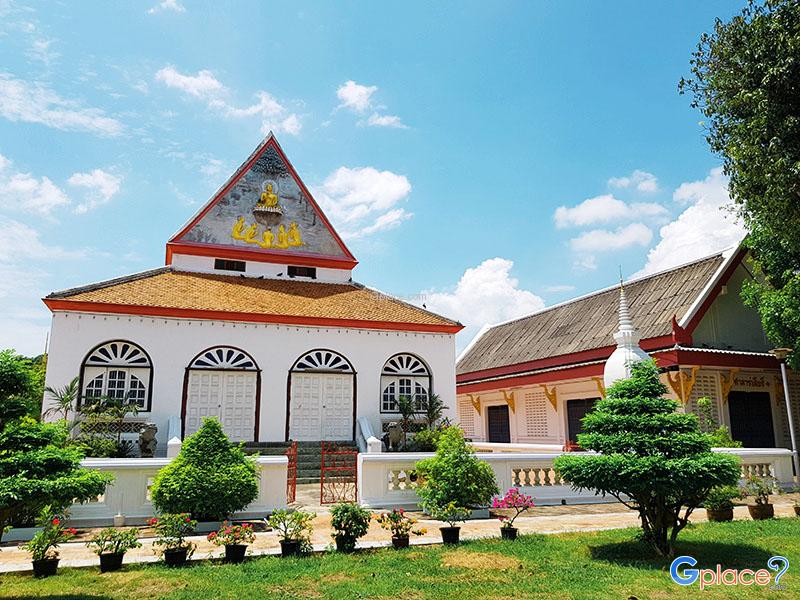
Wat Suwannakhiri is an ancient temple of great historical importance to Songkhla, located in Singhanakhon District on the Laem Son side, which once served as the old administrative center of Songkhla before the city was later moved to the Bo Yang side. The temple is therefore not only a religious site but also a significant historical record reflecting political structure, governance, and local ways of life during the early Rattanakosin period. It is closely associated with Phraya Suwan Khiri Sombat (Bun Hui), the then-governor of Songkhla, who played a key role in restoring and developing the temple as a religious and ceremonial center of the town. The temple was also used for important royal oath-taking ceremonies (Nam Phithiprat Satya), highlighting its role as a space linking religion and state administration.
In terms of architecture, Wat Suwannakhiri stands out for its harmonious blend of Thai, Chinese, and Western influences. The ordination hall follows traditional Thai style and contains mural paintings depicting the life of the Buddha, reflecting the craftsmanship of early Rattanakosin court artisans. In front of the temple stands a Chinese-style granite stupa known as a “tha,” built in 1797 with inscriptions identifying its founder, reflecting the influence of Chinese immigrants who played an important role in Songkhla’s trading port society. The bell tower also shows a unique combination of Chinese and Western architectural styles, representing cultural exchange in a historic port city.
The temple is also significant in archaeology, as it has been registered as a national heritage site by the Fine Arts Department due to its importance in understanding early settlement patterns and the historical transformation of Songkhla. In addition, local legends surround certain stupas, including beliefs that natural rock formations emerged on their own, as well as spiritual beliefs regarding the sacredness of the area used for protecting the stability of the city in the past.
Overall, Wat Suwannakhiri is more than just a temple; it is a cultural landscape that reflects the blending of Thai, Chinese, and Western civilizations, serves as evidence of historical power structures, and provides deep insight into the development of Songkhla from a traditional port city to its role in the early Rattanakosin era—making it one of the most important heritage sites in southern Thailand.

 Attractions
  Hotel
Hotel  Restaurant
  Shopping
  Abroad







 Share
Share
 Ban Bo Toei, Hua Khao, Singhanakhon, Songkhla 90280
Map
Ban Bo Toei, Hua Khao, Singhanakhon, Songkhla 90280
Map
 Closed today



 51
51